Built on drained prairie
An FIU community profile describes Westchester's land as low-lying prairie that flooded in the seasonal rains, until drainage canals turned it into land people could build on.
Miami-Dade County
When the Tamiami Canal runs high, rain has nowhere fast to go. Call when it gets inside, and soaked baseboards and low drywall get pulled and dried.
ZIP codes in the area
Some of these ZIP codes also include neighboring communities.
Westchester went up fast after World War II on flat, low land west of the Palmetto Expressway, and most of its homes are one-story block houses on a concrete slab. South Florida Restoration Co sets up water damage restoration in Westchester, the City of West Miami and Tamiami, whether storm water pushed in from the yard or a supply line let go inside a wall.
The Tamiami Canal, the C-4, was dug in the 1920s to build the Tamiami Trail, and today it carries storm water for a big piece of west Miami-Dade. It drains mostly by gravity. When a storm fills it faster than it can empty, the swales, yards and low streets that drain into it have to wait. In a May 2020 storm it rose 2 feet in about three and a half hours near the Palmetto.
Hurricane Irene in 1999 and the No Name Storm in 2000 both caused flooding along the canal. The 2000 storm alone flooded more than 90,000 homes in Miami-Dade. Afterward, the South Florida Water Management District built a 900-acre emergency detention basin in west Miami-Dade to hold overflow from the canal, along with pump stations and stronger canal banks. Flooding still happens. In 2020 the county proposed buying out a Tamiami house because it kept taking on water.
Water that came across the yard or up from the street isn’t clean. Wet carpet and baseboards get pulled, the lower drywall is cut out above the wet line, and the slab is washed before any air movers are set up. That makes it flood cleanup, not a plain dry-out.
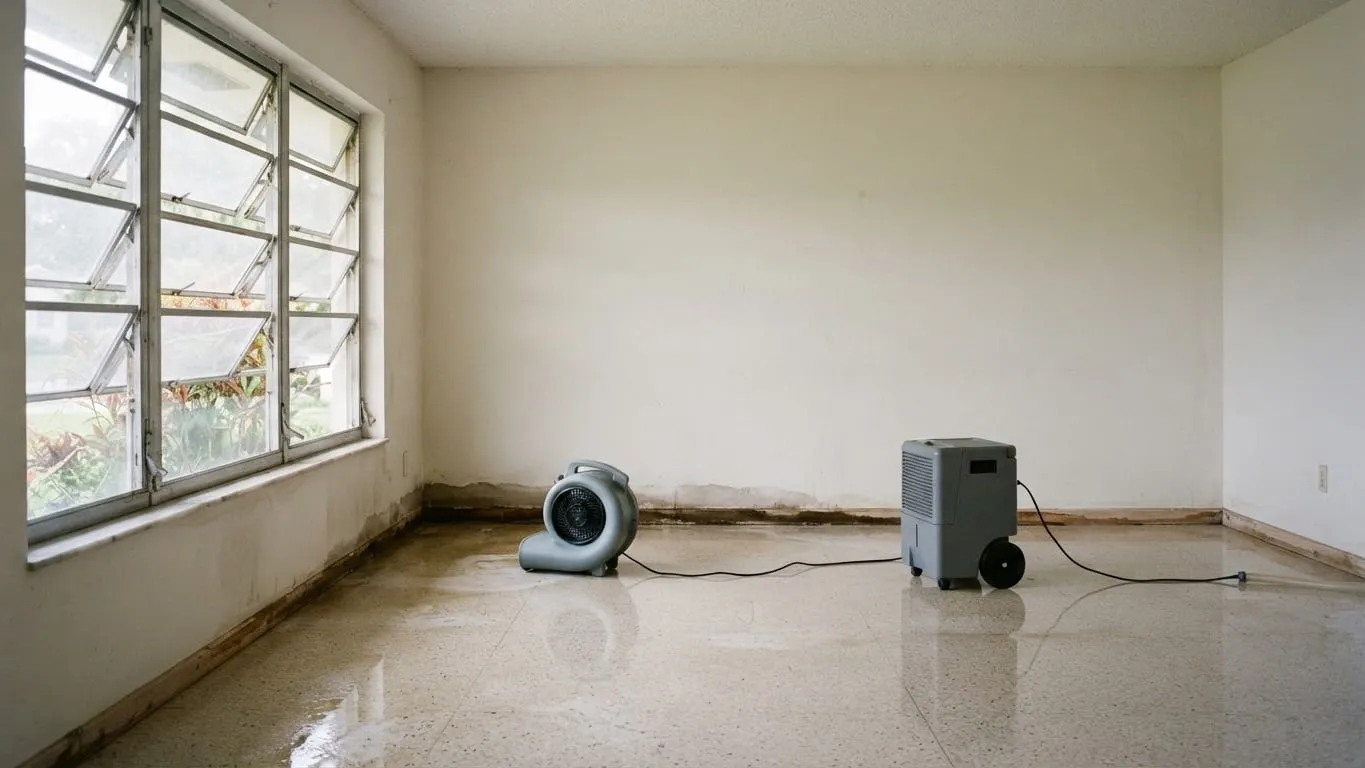
Seven in ten Westchester homes date from the 1950s, 1960s and 1970s. Miami-Dade County’s historic preservation guidelines call the one-story ranch house the model for the county’s postwar suburbs, Westwood Lakes on Westchester’s south edge among them. A ranch house sits on a slab at grade with block and stucco walls, so the floor is low, and the county notes that in low-lying areas it can sit below the flood elevation. Water that gets in has nowhere to drain. It runs out over the slab beneath the tile and the furniture until something stops it.
The outside walls are concrete block, usually with furring strips and drywall or plaster on the inside face. Water that gets behind that inside layer, from a window, a door or a leak in the next room, sits against the block where nobody can see it. The drywall face can read dry while the block behind it is still wet, so the readings go into the wall, not only across its surface. What a dry-out looks like shows how those readings get tracked day to day.
The City of West Miami covers less than a square mile between Tamiami Trail and Coral Way, and it was incorporated in 1947. Close to half of its houses date from the 1940s and 1950s. About 3 in 10 are from the 2010s, and close to a third are in towers with 50-plus units. Half of households rent.
That means two different jobs on the same few streets. In the older houses, the water usually starts at an old fitting, a water heater or a drain line. In the towers, a leak travels down and sideways into the units around it. If water is dripping through your ceiling, see what to do when the condo upstairs leaks.
More than half of Tamiami’s housing dates from the 1980s and 1990s. About 15 percent of the housing is townhouses and about 6 percent mobile homes. In a townhouse, a split washer hose or toilet line can soak the shared wall and show up next door first. Under a mobile home, water collects in the insulation and the barrier below the floor, so the floor gets opened from underneath to dry.
Homes in 33144, 33155, 33165, 33174, 33175, 33184, 33185 and 33194 are covered, even when the envelope says Miami. Don’t see your ZIP? Call anyway and we’ll check your address.
Mention whether the water began outside or inside the house, which rooms it reached and whether it’s still running. If the canal or the street is still high, say that too.
Services
An FIU community profile describes Westchester's land as low-lying prairie that flooded in the seasonal rains, until drainage canals turned it into land people could build on.
The Tamiami Canal (C-4) relies mostly on gravity to drain to the coast. In a May 2020 downpour it rose 2 feet in three and a half hours near the Palmetto Expressway, WLRN reported.
Seven in ten homes here date from the 1950s, 1960s and 1970s, and half were built by 1971, by 2024 Census estimates.
In 2020 Miami-Dade County proposed buying out a house in Tamiami because it kept flooding, one of ten buyouts the county planned, WLRN reported.
FAQ
Yes. Most of Tamiami is in 33175 and 33184, and both are covered. Part of Sweetwater sits in 33174, which is covered too. For any other Sweetwater address, call and we'll check it.
It can be. A hot water line leaking under the slab often shows up as a warm, damp patch, loose tiles or a dark mark low on the wall. The line has to be repaired before the drying can finish, and moisture readings show how far the water spread under the floor.
Block walls hold water longer than the drywall or plaster on their inside face. Water that ran down inside the window opening can sit in the block and behind the furring strips long after the paint feels dry. Readings on the wall tell you when it's actually dry.
Call now
Shut off the water if you can reach the valve safely, then call. Describe where it came from and which rooms are wet.
When you call, have ready