Short answer
Keep the AC on and set it to control humidity, with a humidistat or a daily run schedule, since a thermostat parked at 85 often doesn't run long enough. The EPA says keep indoor humidity under 60 percent. Shut the water off at the main or unit valve, and have the AC drain line cleared before you go.
Closing up a Florida home for the summer is mostly a humidity job. A South Florida condo or house that sits locked for months fills with damp air unless the AC keeps pulling it out, and mildew starts on leather, wood, fabric and closet walls. If the trip home turns up a musty smell, a leak or spots on the furniture, South Florida Restoration Co can get a licensed, insured crew started on the mold remediation and drying.
Where should the thermostat sit while you’re gone?
Don’t switch the AC off. Florida Solar Energy Center researchers found that a closed house left to “float” with no AC averaged about 70 percent relative humidity, the level they treated as the point where mold growth becomes likely.
Pushing the thermostat up to 85 isn’t much better. In that research, an 85 setting often didn’t run the system long enough to dry the air, because the AC only kicks on to cool. What worked was running it on a schedule every day or putting it under a humidistat, so it runs whenever the air gets damp, not only when the house gets hot.
For any home, the EPA puts the line at 60 percent indoor humidity, with 30 to 50 as the range to aim for. If your thermostat has a dehumidify or humidity setting, use it.
Check the AC drain line before you lock up
A condensate line that clogs is the leak that waits for an empty house. The air handler makes water every time it runs, and if the line backs up, the pan overflows into the closet, the wall or the unit below.
Florida code calls for overflow protection on these systems, often a float switch, which cuts power to the system once the pan fills. That stops the leak, but the system then stays down for the rest of the summer while humidity climbs. UF/IFAS Extension suggests having the system serviced a few weeks before you leave, including the pan and the drain line. AC leak water damage explains how far an overflow spreads into the closet and nearby walls.
Before you lock the door
- Set the AC to humidity control or a daily run schedule, never off.
- Shut the water off at the main, or at the unit valve in a condo.
- Turn the water heater off for a long trip, or to its lowest setting for a short one.
- Have the condensate line and drain pan cleared.
- Cover toilets and stop the drains. UF/IFAS Extension notes that when drain traps dry out, sewer gas and pests can come up through them.
- Leave interior and closet doors open so the dry air reaches every room.
- Give someone a key and ask them to look in now and then.
What does a humidity bloom look like?
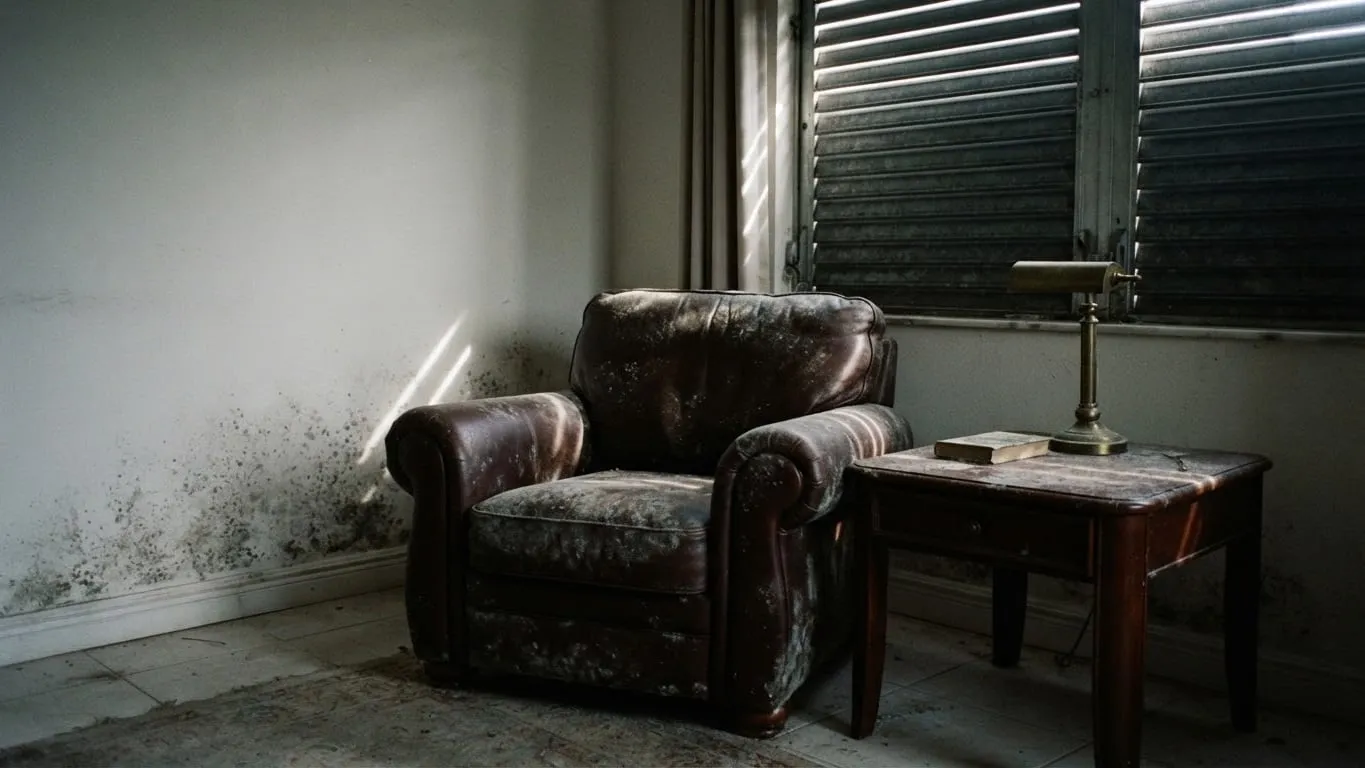
A leak leaves mold in one spot, near the water. A humidity bloom spreads thin across the whole place. You open the door to a stale, musty smell, then find a dusty white, gray or green film on leather chairs and shoes, wood furniture, clothes in the closet, the walls behind pictures, and the grilles on the AC vents.
UF/IFAS Extension describes mildew as growing best between 77 and 86 degrees, in dark spots with little air moving, on leather, paper, fabric and wood. A shut house with the thermostat pushed up sits right in that range all summer.
Spots that are heavier in one room, low on one wall or under a window point to water, not air. The signs of hidden water damage guide lists where to look for it.
Back home and it smells musty
Turn the AC on and let it run, and leave the windows shut, since outside air here carries more moisture than the air you want inside. Look in the places water collects first: the AC closet, around the water heater, under the kitchen and bathroom sinks, and on the ceilings. Take photos of any spots and stains before anything gets wiped or moved.
Growth past a small patch, a smell that stays after a day of AC, or spots tied to a leak is a job for mold remediation. The crew finds the moisture source, contains the area, removes what can’t be cleaned and dries what stays.
Over the phone, tell us how long the home sat closed, where the AC was set, if you found any water, and which rooms and surfaces have spots.