Short answer
King tides are the year's highest tides, and in South Florida the biggest ones come in the fall, roughly September through November. Salt water can then back up through storm drains, spill over low seawalls and rise through the porous ground under a clear sky. If it gets indoors, the cleanup follows the rules for outside flood water.
A king tide can put salt water in a garage, a lobby or a ground-floor unit on a clear afternoon. South Florida Restoration Co is the number to call about king tide flooding near the canals, the bay and the Intracoastal, from Miami-Dade north to Martin County. Tell us where the tide got in, and we’ll get a licensed, insured crew out to rinse the salt off, extract what’s left and dry the slab and walls.
What is a king tide?
“King tide” isn’t a scientific term. NOAA uses it for the exceptionally high tides that come when a new or full moon lines up with the moon’s closest pass to Earth, called a perigean spring tide. That happens six to eight times a year, and NOAA says those tides can run more than a foot above other spring tides.
Here the biggest ones come in the fall. The City of Fort Lauderdale lists September, October and November as its highest-tide months, and Miami-Dade County says rising seas make these tides come more often, last longer and reach farther inland. A tide that only wets the street can come over the curb when an onshore wind or a storm stacks water against the coast.
Why does the street flood when it isn’t raining?
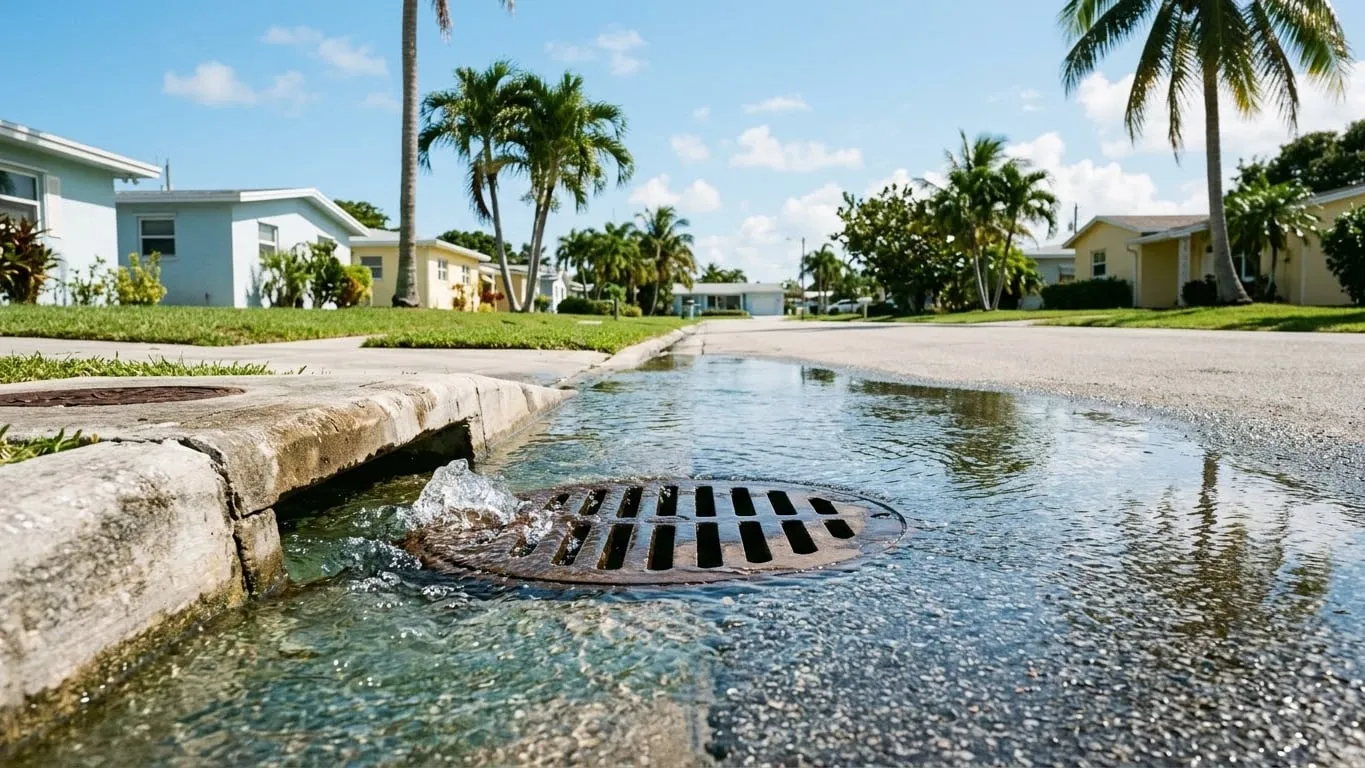
NOAA calls it high tide flooding, or sunny day flooding, and says the minor version causes stormwater backups and road closures. Water gets in three ways:
- Up the storm drains. Drains on most coastal streets empty into a canal or the bay. When the tide sits higher than the outlet, salt water runs backward up the pipe and out the grate. Tidal valves let rain out and close against the tide, but they only seal when kept clean, which is why Fort Lauderdale checks and cleans its own every quarter.
- Over the seawall. A low or crumbling seawall lets the tide straight into the yard. Fort Lauderdale now requires new seawalls to reach at least 5 feet and says deteriorating private walls add to tidal flooding on the roads.
- Up through the ground. South Florida sits on porous limestone. On a high tide, salt water moves through the rock, lifts the water table and can bubble out of drains blocks from the shore.
The Fort Lauderdale and Delray Beach pages cover what those cities face street by street.
What does salt water do to drywall, wood and stored boxes?
Salt doesn’t leave with the water. It stays in the drywall’s paper face, in baseboards, door jambs and cabinet toe kicks, and keeps pulling dampness from the muggy air. A wall that dried out can read damp again a week later. Salt also throws off the moisture meter, because it carries current and makes the wall look wetter than it is.
Restoration drying guidance treats sea water flooding as Category 3, and its first step is to flush the area with fresh water and extract it before any drying. Bins, tools and furniture that can be washed get washed first too, because salt left on them dries into white stains and tide lines. Soaked cardboard and papers usually don’t make it.
Garages, lobbies and first-floor units flood first
The garage slab is usually the lowest floor of a house, and a door seal won’t stop water rising from the driveway. Watch the garage wall that backs onto the living space: tide water wicks up its drywall and can reach the room behind it. Keep water heaters, washers and freezers that sat in salt water off until someone qualified looks at them.
In a building, it’s the parking level, the storage room, the lobby and the units nearest the water. See flood cleanup for how outside water comes out, and flood water vs. leak water for why it changes what gets removed.
Tide water got inside. What now?
- Stay out of standing water near outlets and appliances, and switch off the breakers for that area when the panel sits somewhere dry.
- Move the car to higher ground before the next high tide.
- Photograph how high the water marked the walls before anything gets moved.
- Get boxes, rugs and anything else on the floor up onto shelves or into a dry room.
- Call us and say it was tide water.
On the call, let us know if the water showed up at peak tide or during rain, how high it reached, which rooms or garage walls it touched and whether it’s come back on more than one tide.