Short answer
The usual signs are a musty smell that won't clear, paint that bubbles or peels, baseboards that swell or split, floors that feel soft or start cupping, stains that grow, and a water bill that rises with no change in use. Moisture readings through the surface show where the wet area ends before any wall is opened.
Hidden water damage starts where nobody looks: behind a shower wall, under a sink, beneath vinyl plank or tile, or around the air handler. South Florida Restoration Co covers hidden leaks in homes and condos across Miami-Dade, Broward, Palm Beach and Martin counties. Tell us what you’ve spotted, and we’ll get readings taken in the walls and floors, the water traced and the wet spots dried before a slow leak turns into a mold job.
What does hidden water damage smell like?
Musty and earthy, like a damp towel left in a bag. It’s usually strongest in one spot, such as a closet, a sink cabinet or the room beside a bathroom, and it gets worse when the AC has been off or the house closed up.
The EPA says you may suspect hidden mold when a building smells moldy but you can’t see the source. A smell with no visible water is a reason to get readings, not to keep spraying air freshener.
Clues on walls, baseboards and doors
- Paint that bubbles, blisters or peels, most often low on a wall or around a window.
- A stain with a darker outer ring that grows a little each week.
- A stain that was painted over and came back. Paint covers the mark, not the water behind it.
- Baseboards that swell, split at the joints or start leaning off the drywall.
- Caulk at the tub or along the baseboard that separates and won’t stay sealed.
- A door that used to close fine and now sticks or rubs at the frame.
Any one of these can have another cause. Two or three in the same corner usually mean water.
Feeling for it in tile, vinyl plank and wood floors
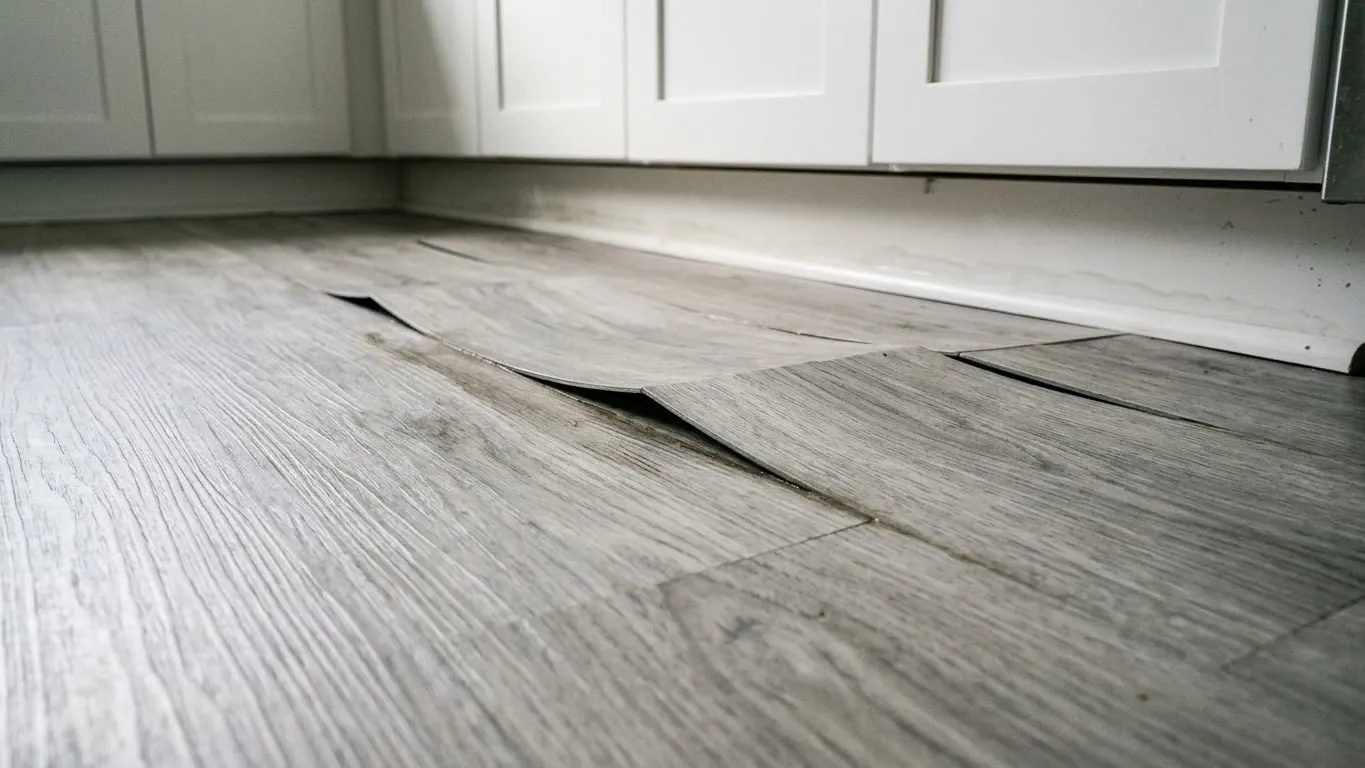
Most homes here sit on a concrete slab, and water that gets under the floor covering spreads along the slab with nowhere to go.
Vinyl plank sold as waterproof keeps water out of the plank itself, not out from under it. Look for planks peaking at the seams, edges that lift, a soft spot underfoot, or water squeezing up between boards when you step down. Laminate swells and flakes at the joints. Tile gives itself away with grout lines that stay dark after the floor is dry, or tiles that sound hollow or rock. Wood floors cup, with the edges of each board higher than the middle. Carpet turns damp and sour-smelling along the wall.
Where hidden leaks start in South Florida homes
| Spot | What usually feeds it | What you notice first |
|---|---|---|
| Behind the washer | A worn fill hose or the valve box in the wall | A swollen baseboard behind the machine, a musty laundry room |
| Under kitchen and bathroom sinks | Supply lines, drain joints, the dishwasher line | A cabinet floor that’s swollen or soft, a stain on the back panel |
| Around the air handler | A plugged condensate line or a pan that’s rusted through | Wet carpet right outside the closet, a brown ring overhead |
| The wall behind a shower | Failed grout or caulk, the shower valve, a cracked shower pan | Bubbled paint or a stain on the other side of the wall, loose tile |
| Near the water heater | A dripping fitting or a pan that doesn’t drain | Rust at the base, a damp baseboard outside the closet |
| Under the fridge | The ice maker or water line | A swollen toe kick, planks lifting in front of the fridge |
An air handler closet with these clues is its own job, laid out under AC leak water damage, and the water heater leak guide covers the tank and its pan.
The water bill went up for no reason
A leak inside a wall or under the slab runs under pressure all day, and the bill often gives it away before the floor does. The EPA’s WaterSense program says to check the meter before and after a two-hour stretch with no water running; if the meter moves at all, you probably have a leak. Its numbers say nine percent of homes have leaks that waste 50 gallons or more a day.
Finding the wet area without tearing into walls
Moisture readings do the finding. A meter scanned across the paint, the tile or the floor marks where the material reads wet and where the wet area ends, so the outline of the damage is known before anything is cut. Where a closer number is needed, a pin meter leaves two small pinholes. Baseboards come off so the lowest few inches of drywall can be read and dried.
A wall gets opened only where the readings point to soaked insulation, growth on the back of the drywall or a leak that has to be reached to fix. Growth turns the job into mold remediation, with the area sealed off before wet material comes out. Caught earlier, the walls and floor usually get dried in place through water damage restoration.
On the call, tell us what you noticed first, which room it’s in, and what’s behind that wall or above that ceiling: a bathroom, the air handler closet or a neighbor’s unit.