Short answer
Close the cold-water valve on the pipe above the tank, then switch off the heater's breaker or close the gas valve feeding it. Water from the base usually means the tank itself has failed; water from the relief valve's pipe points to pressure or heat. Then call about drying the floor, baseboards and walls the water reached.
A water heater leak in South Florida lands wherever the tank sits: on a garage slab, in a hall closet, beside the washer in a laundry room, or in a condo utility closet with a neighbor underneath. South Florida Restoration Co sends a licensed, insured crew across Miami-Dade, Broward, Palm Beach and Martin counties to pull up the standing water, take moisture readings and dry the walls, baseboards and flooring the leak reached.
Shutting the heater down
A tank that has split keeps refilling from the cold supply, so the water won’t stop until that line is closed.
- Close the cold-water valve on the supply pipe feeding the tank. If it’s stuck or you can’t find it, close the main shutoff for the house or unit.
- Electric heater: flip its breaker off, as long as the panel sits on dry floor and you don’t have to step through water to get to it.
- Gas heater: turn the gas valve on the line feeding the heater to off.
- Stay back from the base. Water coming out of the tank can be hot.
- Take photos of the heater, the pan and the wet floor before you move things.
With that done, call us. Say where the heater sits and which rooms the water has crossed into.
Is it the tank or the relief valve?
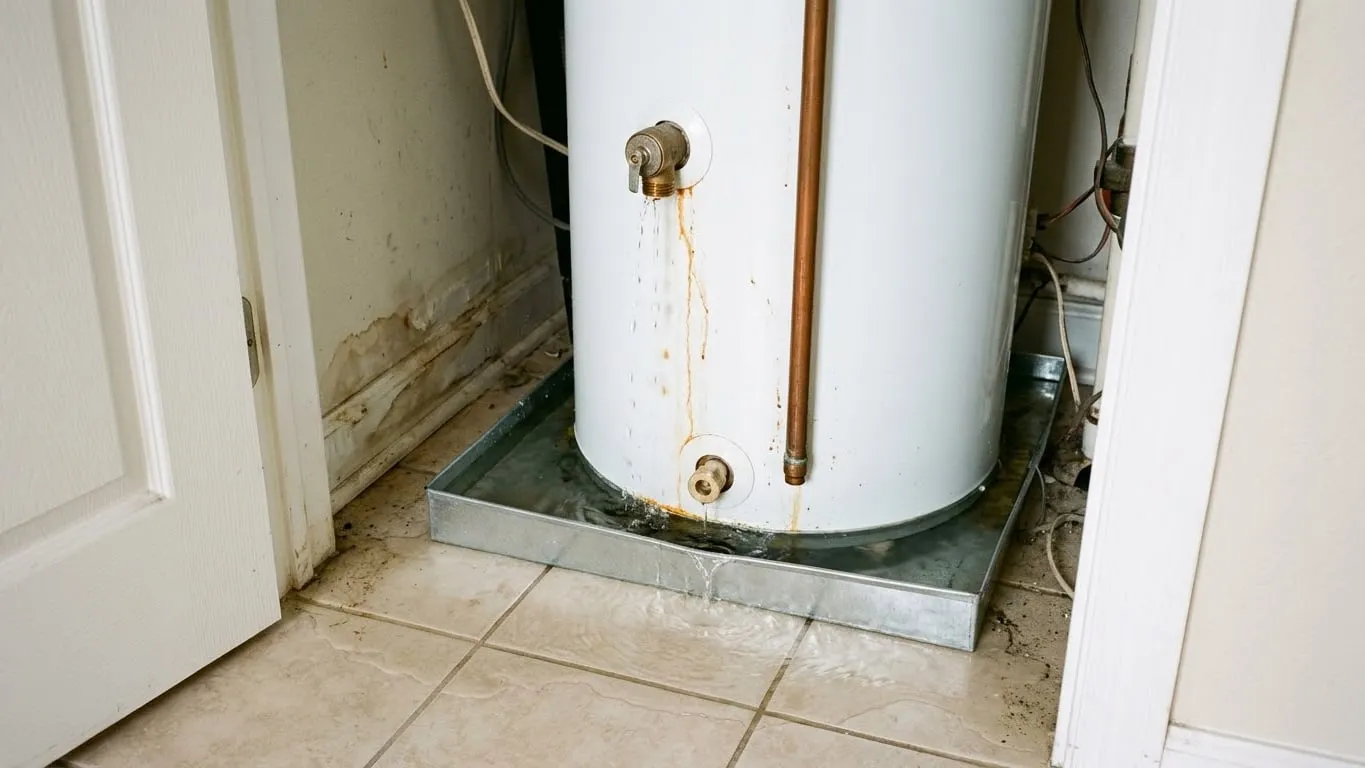
The spot the water leaks from tells you what failed. The heater maker A.O. Smith calls a leak at the base “often the first indication of a serious problem.”
| Where you see water | What it usually means | What it means for the job |
|---|---|---|
| Pooling under the base, rust at the bottom seam | The tank has corroded through | The tank gets replaced; this kind of leak doesn’t slow down on its own |
| Out of the pipe from the relief valve | The valve opened on high pressure or temperature | The valve or the pressure gets sorted out; the water landed near the floor where that pipe ends |
| Running down the outside from fittings on top | A loose or corroded connection | The fitting gets fixed, and whatever the drip soaked on the way down gets read |
| Beads on the jacket, no puddle growing | Condensation, often after a cold refill | Usually clears once the tank heats; a puddle that keeps growing is a real leak |
Florida’s plumbing code has the relief valve pipe end no more than six inches above the floor or a drain, which is why that water so often ends up soaking the closet floor.
Doesn’t the drain pan catch it?
Sometimes. The 2023 Florida Building Code requires a pan under a tank-type heater wherever a leak would cause damage, at least 1½ inches deep and drained through a pipe of at least ¾ inch to a floor drain or outside. That’s plenty for a drip or a relief valve letting go. A tank that splits while the cold supply keeps feeding it puts out water faster than that drain can carry it off, and the pan overflows.
A pan whose drain line is blocked can overflow on a slow drip.
Where the water goes from a garage, closet or condo utility room
In a garage, the water fans out over the concrete, wicks into the bottoms of cardboard boxes stored on the floor, and finds the wall and door that lead into the house. The room on the other side of that wall gets read too.
From a hall or laundry closet, water slips under the baseboard into the next room, soaks the carpet pad and runs under vinyl plank or laminate, where it sits against the slab out of sight. Laundry rooms add cabinets with particleboard bottoms that swell.
Above the ground floor, a condo utility closet sits over someone else’s ceiling. The water you mop up is part of the leak; the rest may already be in the unit below. For the neighbor’s side of it, see the condo guide for water coming through from upstairs.
Drying out after the heater is shut down
Any water still on the floor gets pulled up first with emergency water removal. Tank water starts out as clean supply water, so drywall that soaked it up can usually stay if drying begins early. The crew pulls the baseboards to open the base of the wall to air, lifts wet carpet pad and the tack strip under it, and sets air movers and dehumidifiers. Readings get taken each day until the closet walls, the framing and the slab read the same as a dry room. How that drying plays out, day by day, is part of water damage restoration.
When you call, mention whether the heater is gas or electric, whether it’s off now, roughly how long it leaked, and which room shares a wall with the closet or sits below it.