Nearly a fifth of homes built before 1950
About 18 percent of homes in Coral Gables went up before 1950, and the typical home was built in 1969, by 2024 Census estimates.
Miami-Dade County
Tile roofs, thick stucco walls and canals to the bay all change how a Gables house gets wet. Call, and the water gets traced and the rooms dried.
ZIP codes in the area
Some of these ZIP codes also include neighboring communities.
Coral Gables was planned in the 1920s around Mediterranean-style houses, and nearly a fifth of its homes predate 1950. For water damage restoration in a Granada house under barrel tile, a canal-front home in Cocoplum or a downtown condo, tell South Florida Restoration Co which rooms are soaked, and we’ll get a licensed, insured crew drying it out.
The city’s design guidelines list gable, hip and parapet roofs for its Mediterranean houses, with terra-cotta barrel tile on the pitched ones. One house can have both: tile slopes over the main rooms and a flat section behind a low parapet wall, drained through scuppers.
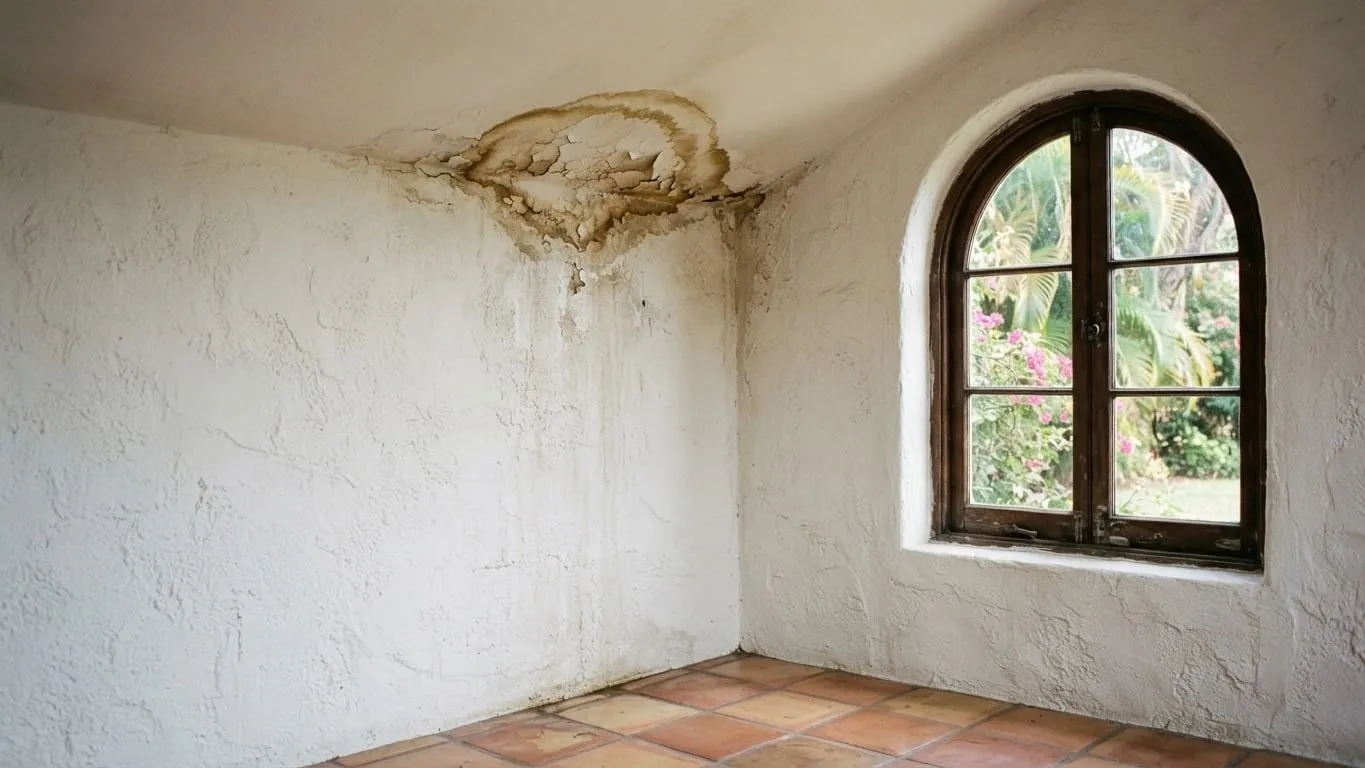
Each one leaks its own way. Under tile, rain that slips past a cracked or shifted piece runs down the underlayment until it finds a nail hole or a seam, so the ceiling stain often shows up a room away from the damage. On a flat section, a scupper clogged with leaves holds a pond against the parapet, and the water works into the wall and the ceiling below it.
Inside, wet insulation above the ceiling holds water against the drywall for days, so the attic side gets read as well as the room. If the ceiling is sagging, keep people out from under it and read how to handle a leaking ceiling.
Merrick’s early rules said every house had to be coral rock or stucco, and a 1920s account quoted in the city’s guidelines describes stucco over cement tile blocks made in Coral Gables itself. Those walls are solid masonry with plaster or stucco on the faces, and they hold water a long time after a window leak or a failed supply line.
That changes the dry-out. Instead of cutting out wall to let air in, the crew aims air movers at the masonry, runs dehumidifiers and tracks moisture readings until the wall comes back dry, which can take longer than drywall. Houses this age may still have galvanized supply pipe or cast-iron drains, and a slow drip behind the plaster keeps it damp until the paint starts to bubble.
Canals reach into the city from Biscayne Bay, including the Coral Gables Waterway and the Deep Waterway in the south Gables. In Hurricane Irma, the National Hurricane Center reported 4 to 6 feet of water above ground in parts of Miami-Dade, mostly along the bay, and a high water mark at Matheson Hammock Park stood 5.1 feet above ground. A 2022 Miami Herald report named Gables by the Sea among the bayside communities prone to some of the worst surge flooding in South Florida. The city notes king tides hit hardest along the coast and in low spots near other water, usually in the fall.
Bay water that comes over a seawall or up the canal is salt water carrying silt. Soaked drywall gets cut above the water line, wet insulation and carpet come out, and the slab and remaining wall surfaces are scrubbed down before drying starts. There’s more on why in the guide to floodwater and leak water.
The city has mapped 19 possible sewer basins, including Snapper Creek, Riviera, Granada and Hammock Lakes, for homes still on septic. When days of rain saturate the ground, an old tank has no room to drain, and the overflow comes out of the lowest tub or shower drain. That’s sewage cleanup, with porous materials removed and everything else disinfected before any drying.
Homes and businesses in 33114, 33133, 33134, 33143 and 33146 are covered. 33133 is mostly Coconut Grove, and 33143 reaches into South Miami. Much of the south Gables along Old Cutler Road uses 33156 or 33158, covered on our Kendall and Cutler Bay pages. Don’t see your ZIP? Call anyway and we’ll check your address.
Lead with a rough age for the house when you phone, then say whether the water came through the roof, in from the canal side or out of a pipe, and which rooms it reached.
About 18 percent of homes in Coral Gables went up before 1950, and the typical home was built in 1969, by 2024 Census estimates.
The city's design guidelines call for terra-cotta barrel tile on pitched roofs, and George Merrick's 1924 rules required every house to be built of coral rock or stucco.
After Hurricane Irma in 2017, a high water mark surveyed at Matheson Hammock Park on Biscayne Bay stood 5.1 feet above the ground, according to the National Hurricane Center.
Miami-Dade's 2018 septic report found about 2,930 home parcels in Coral Gables still on septic, and the city says many of those systems were installed decades ago and are failing as groundwater rises.
Services
FAQ
Often it is. Water that gets under a cracked or shifted barrel tile rides the underlayment downhill and comes through wherever it finds a gap, so the stain can sit well away from the bad tile. The ceiling and the insulation above it get read for moisture, and drying holds once the roof is sealed.
Stop running water anywhere in the house, close the bathroom door and keep kids and pets out. Saturated ground can leave the tank with nowhere to drain, so it pushes back up the lowest drain. Anything soft the backup touched is treated as sewage and removed.
Yes. The south Gables along Old Cutler Road is covered, whether the address reads 33143, 33156 (on our Kendall page) or 33158 (on our Cutler Bay page).
Usually not. Plaster on masonry doesn't fall apart when it gets wet the way drywall does. It dries slowly, so the crew sets equipment against it and takes readings into the wall until they come back dry. The only plaster that comes off is plaster that pulled loose from the wall or got soaked by dirty water.
Call now
Shut off the water if you can reach the valve safely, then call. Describe where it came from and which rooms are wet.
When you call, have ready