Back-to-back hurricane landfalls
In September 2004, the centers of Hurricane Frances and Hurricane Jeanne both crossed the coast at the southern end of Hutchinson Island, a short way east of Stuart, according to the National Hurricane Center.
County service area
Most Martin County homes are houses on their own lot, many on septic. Call, and whatever got inside, storm water or a backup, gets cleaned out and dried.
When you call South Florida Restoration Co about water damage in Stuart, Palm City, Hobe Sound or Port Salerno, the first thing we sort out is where the water came from: a roof in a storm, a septic line after heavy rain, a burst line under a manufactured home or the river over a seawall. Each one gets cleaned and dried a different way.
Frances and Jeanne came ashore three weeks apart at nearly the same spot. Frances made landfall at the southern end of Hutchinson Island on September 5, 2004, pushing a 5.89-foot surge at the St. Lucie Lock and dropping 6.57 inches of rain on Port Salerno. Jeanne crossed the coast there again, just east of Stuart, on September 26. Storms like those push rain in at lifted shingles and tiles and around windows and sliding doors, and it soaks into attic insulation and ceiling drywall. A ceiling can look fine from below while the insulation above it stays soaked, so the attic gets checked along with the room. If the ceiling is stained or sagging, the ceiling leak guide shows the signs that wet drywall is about to come down.
Newer storms keep testing the same roofs. When Hurricane Milton’s tornadoes crossed the county in October 2024, the damage assessment in NOAA storm records counted 278 structures affected and 29 destroyed.
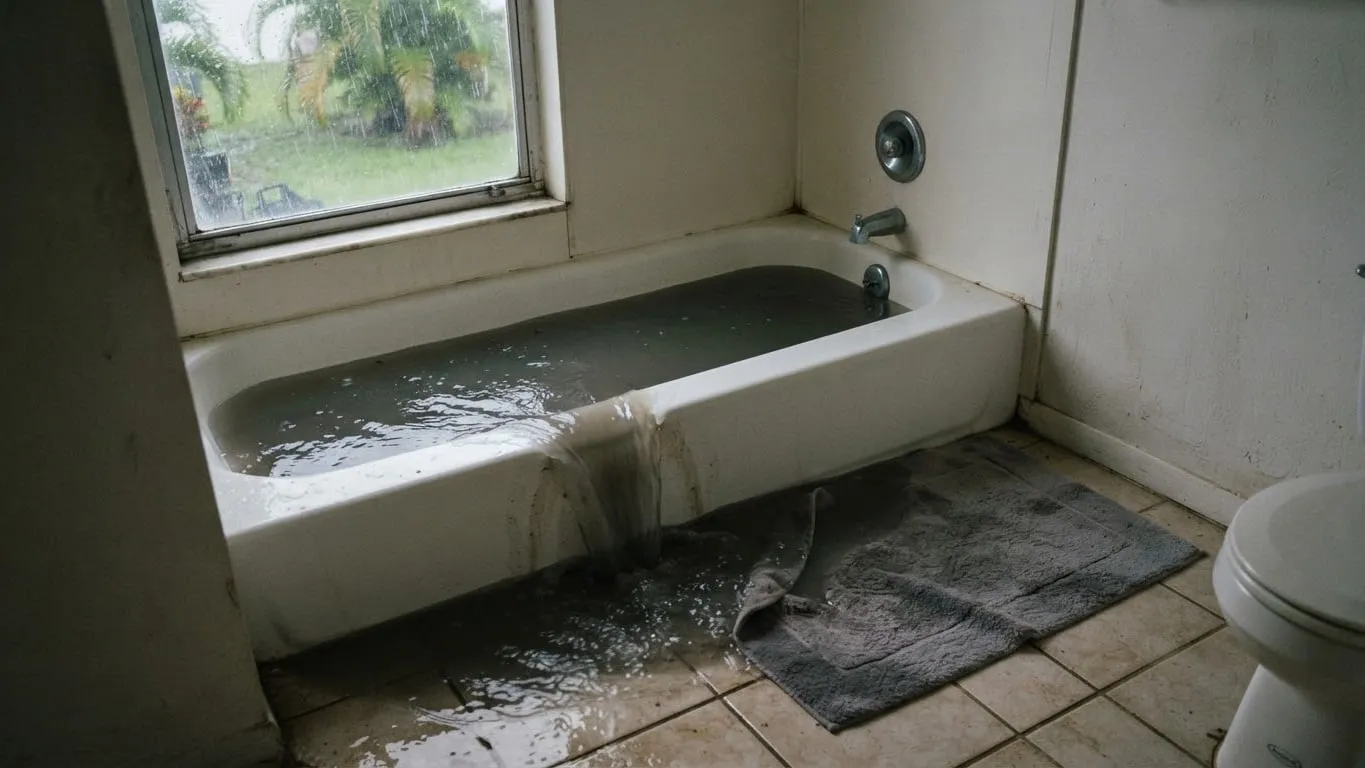
After days of heavy rain, the drain field sits in saturated ground and can’t take any more water. The next flush or shower comes back up through a tub, shower or toilet. Even if it looks clear, it’s sewage, and porous materials it reached come out. More on that in sewage cleanup.
A manufactured home sits on piers, with insulation and a vapor barrier sealed under the floor. Water from a burst line or a storm gets trapped there and soaks the insulation and the subfloor, often particleboard that swells and crumbles when it stays wet. So drying starts underneath: the barrier gets opened, the wet insulation comes out and air movers go under the floor before the rooms above are finished.
On the St. Lucie River and the Indian River Lagoon, a high tide or a storm can push water over the seawall and up the yard into the garage. Martin County’s king tide page says the highest tides usually come in October and November, and on September 21, 2020, a king tide with storm swells put river water onto roads and properties in Palm City, Stuart, Sewall’s Point and Port Salerno, NOAA storm records show. That water is brackish. The salt it leaves keeps drywall and trim from drying out, so they get washed as well as dried, and anything that sat in it long enough is replaced.
Our Stuart page covers Stuart, Port Salerno, North River Shores and the Town of Sewall’s Point. Palm City has its own page across the river, and our Hobe Sound page takes in Hobe Heights, Banner Lake and Jupiter Island. South of the county line, northern Palm Beach County is covered on our Jupiter page.
Every Martin County community and ZIP code we cover is listed below. Don’t see yours? Call anyway and we’ll check your address.
If water is in the house now, call and tell us where it came from, whether you’re on septic and whether it’s a manufactured home. That decides which equipment goes out first.
In September 2004, the centers of Hurricane Frances and Hurricane Jeanne both crossed the coast at the southern end of Hutchinson Island, a short way east of Stuart, according to the National Hurricane Center.
The county estimates there are about 32,000 septic systems in Martin County, many of them close to the shoreline.
Census estimates count about 9 percent of the county's housing as mobile or manufactured homes, which take water under the floor differently from a house on a slab.
Close to half of the county's homes were built between 1970 and 1989, and most are single-family houses rather than condos.
Services
FAQ
Yes. When the drain field is saturated, waste water has nowhere to go and comes back up through the first drain it reaches, usually a tub, shower or toilet. Stop running water in the house, keep everyone out of the room and treat everything it soaked as sewage.
Yes. All three are listed further down this page by community, with their ZIP codes, alongside Stuart.
Yes. Water from the St. Lucie River or the Indian River Lagoon that comes onto the property is outside water, so whatever it soaked inside the garage and along the wall shared with the house is cleaned before drying. The salt in brackish water also keeps drywall reading wet until it's washed out.
Call now
Shut off the water if you can reach the valve safely, then call. Describe where it came from and which rooms are wet.
When you call, have ready