Rain that has to be pumped out
Acme Improvement District, created in 1953 to drain this part of western Palm Beach County, moves the village's rain through canals and pump stations to the C-51 canal and a stormwater treatment marsh to the west.
Palm Beach County
Wellington's rain drains through canals and pumps, so storms leave it in yards. Call as soon as it reaches the house, and drying starts the same day.
ZIP codes in the area
Some of these ZIP codes also include neighboring communities.
South Florida Restoration Co is who to call for water damage restoration and flood cleanup across the Village of Wellington, in gated communities and on horse properties in the Equestrian Preserve. Rain from the yard, a septic backup and a burst supply line each need a different setup.
Wellington was Everglades marsh until a levee went up in 1952 and 1953, and it still depends on pumps. Acme Improvement District’s canals and pump stations move the village’s rain to the C-51 canal and a treatment marsh to the west. An ordinary storm drains fine. In a long one, water waits in swales, yards and streets until the pumps get ahead of it. During Isaac in 2012, about 17 inches fell in three days, and the southern Equestrian Preserve was the last area to drain.
Water that stood in the yard and then came inside has run across lawn, pasture and road, so it’s flood cleanup: wet drywall is cut out, flooring and padding come up, and what stays is cleaned before the dehumidifiers go in.
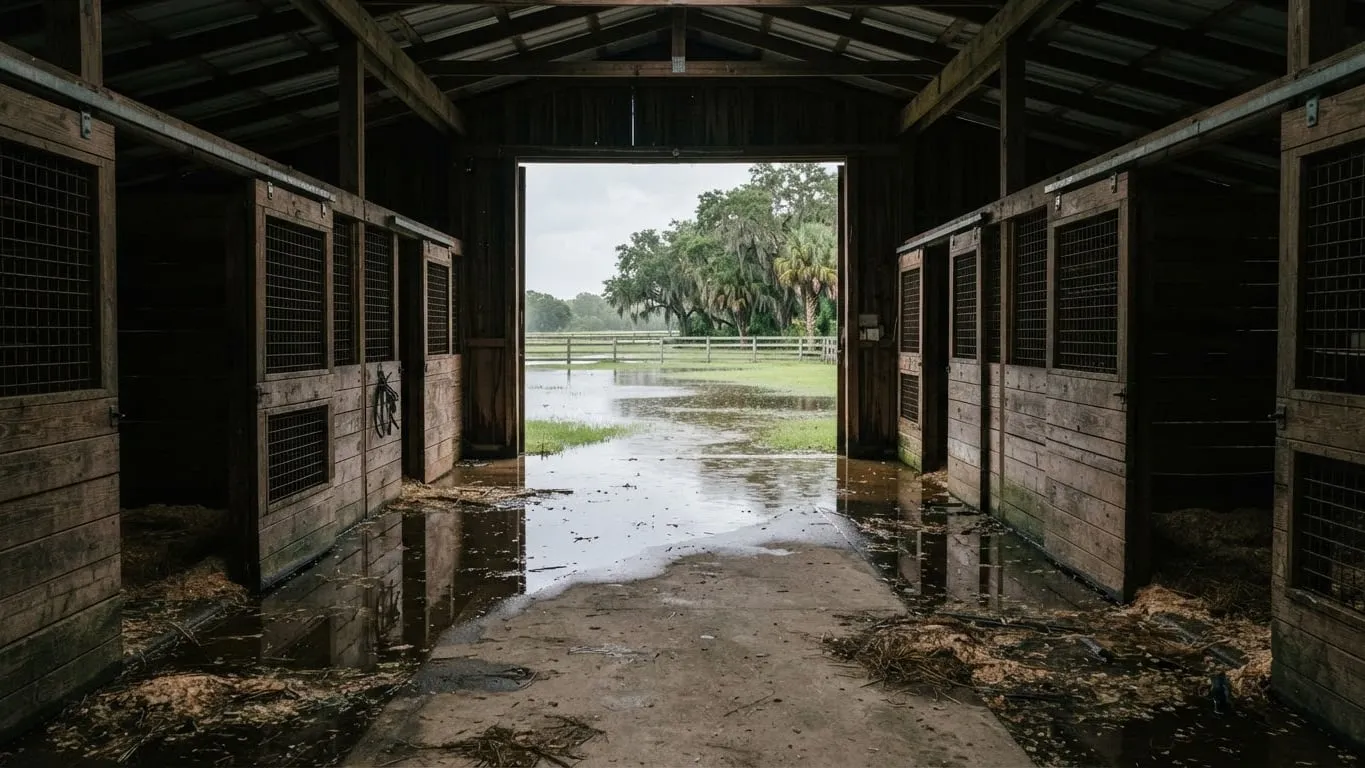
On farms in Palm Beach Point, Saddle Trail and the rest of the Equestrian Preserve, the main house is often one of several buildings that took water. FEMA’s maps keep most Wellington houses out of the high-risk zone, but barns, pastures and outbuildings on the same lot can sit inside it. A groom’s apartment or guest house gets dried like the house. Stalls and barn aisles don’t. Water that ran through them carries manure, so anything porous it soaked is treated as contaminated.
Some older neighborhoods, Paddock Park among them, still run on septic tanks and private wells, and during Isaac the village reported septic failures in Saddle Trail. A tank can’t drain into ground that’s already full of water. Dark water coming up through a ground-floor fixture during a flood is sewage, so stay out of that room.
Seven in ten Wellington homes are detached houses, and almost none are in high-rises. In houses this young, leaks usually start at something hooked to the plumbing, not the pipes: a toilet supply line, washer hoses, the fridge’s water line, the garage water heater or the AC’s condensate line when it clogs. In a two-story house an upstairs leak often shows first as a stain on the ceiling below. For that, start with the ceiling leak guide.
Two of the village’s ZIP codes, 33449 and 33467, use Lake Worth as the mailing city. Those homes are covered along with 33414. Don’t see your ZIP? Call anyway and we’ll check your address.
On the call, name each building that took water, say if you’re on septic and tell us where the water started: the yard, a drain or a line inside.
Services
Acme Improvement District, created in 1953 to drain this part of western Palm Beach County, moves the village's rain through canals and pump stations to the C-51 canal and a stormwater treatment marsh to the west.
Tropical Storm Isaac dropped about 17 inches over three days in 2012, more than the system was built for, and Aero Club, Binks Forest, Meadow Wood and Oakmont were among the hardest-hit neighborhoods, the Town-Crier reported.
FEMA's 2014 maps put most Wellington houses in Zone X, but barns, pastures and other outbuildings on the same property can still sit in the 1 percent flood zone.
About 62 percent of homes were built in 1990 or later, and 71 percent are detached single-family houses, by 2024 Census estimates.
FAQ
When the ground is soaked, the tank has nowhere to send water, so it can come back up through a tub, shower or toilet on the ground floor. Stop running water, keep people and pets clear of that bathroom and call. Anything that water touched is handled as sewage.
Call and say which rooms have stains or drips. Rain through a roof opening soaks the attic insulation and the ceiling drywall below it, and both have to be dried or taken down before the ceiling sags.
It can. Water hitting one spot day after day can work through stucco cracks and into the wall near the floor. Swollen baseboards or bubbling paint on the inside of that wall are the signs, and a moisture reading shows how far it went.
Call now
Shut off the water if you can reach the valve safely, then call. Describe where it came from and which rooms are wet.
When you call, have ready