South Miami Heights, Goulds and Richmond West are the part of South Miami-Dade where the suburbs run into nurseries, groves and open farmland. South Florida Restoration Co puts water damage restoration and sewage cleanup in motion here, and out this way the first question on the call is often whether the home has a septic tank.
Handling a septic backup in a long wet spell
A septic tank needs dry soil under its drainfield to work. Miami-Dade’s 2018 septic study points out that older systems only had to sit 12 inches above the wet-season water table, against 24 inches under today’s rules, so neighborhoods built earlier have less room to spare. The county allows septic outside its Urban Development Boundary where sewer service isn’t practical, and virtually all of the Redland farm country lies outside that line. Countywide, of the 4,916 homes on septic outside the boundary, the study found 308 where average groundwater already comes within 2 feet of the surface.
South Florida sits on porous limestone, and as the sea rises it pushes groundwater up miles from the shore. After days of rain, a tank in saturated ground can’t drain, and the water comes back up through the lowest toilet, tub or shower. That’s Category 3 water. Carpet, pad and anything soft it reached get thrown out, and hard surfaces are disinfected before any drying starts. Sewage backup first steps covers the first hour, and sewage cleanup covers the rest.
Yards that hold water after a long rain
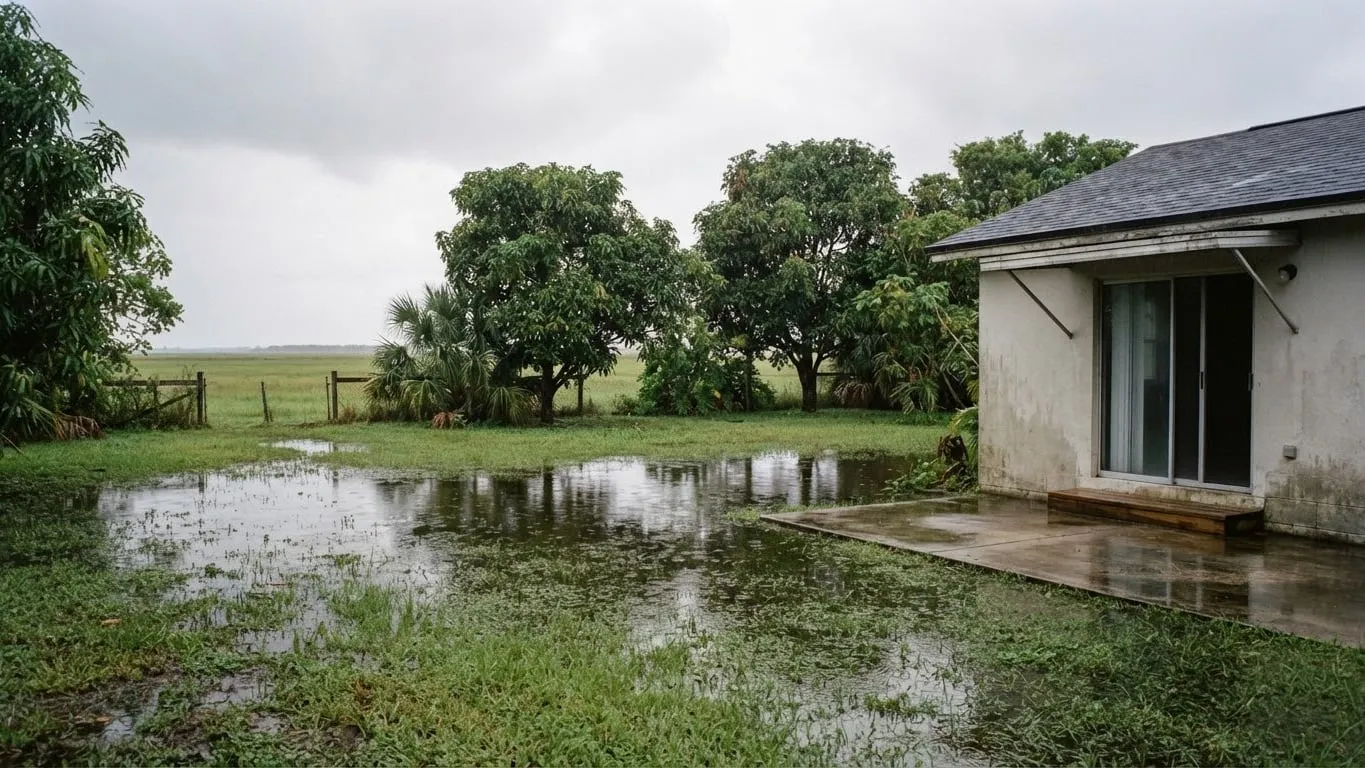
The same high groundwater slows the rain down. The county’s sea level rise task force heard in a 2016 study that areas drained by the canal network “may be more difficult to protect from flooding” as groundwater rises. Two Redland homes made the county’s 2020 buyout list for exactly that: they flooded over and over.
When the lawn stays soft for days, water creeps toward the slab edge, the garage door and the back slider. Anything the yard pushed inside counts as flood cleanup. Soaked drywall gets cut above the line the water reached, and the floor is cleaned before drying equipment goes in.
South Miami Heights, Richmond West and Goulds houses
South Miami Heights is the oldest of the three by median build year, 1978. About 6 in 10 of its homes went up from the 1960s through the 1980s, and nearly a fifth are in large complexes of 50-plus units. Renters make up close to 40 percent of households. In the apartment complexes, a leak upstairs turns into a ceiling stain below, and renters should tell the property manager the same day they call us.
Richmond West grew up after Hurricane Andrew wiped out its mobile home park in 1992. Its population went from about 8,600 in 1990 to almost 36,000 in 2020, and over half of today’s houses are from the 1990s. At 30-some years old, those houses are at the age where original water heaters, supply lines and AC drain pans wear out.
Goulds goes back to a railroad siding in 1903. Its housing mixes 1950s and 1960s houses with a wave of building in the 2000s, and about 44 percent of households rent.
ZIP codes 33170, 33177 and 33187
33177 takes in most of South Miami Heights and about half of Richmond West. 33187 holds the rest of Richmond West and a wide stretch of farm and nursery land to the west. 33170 is Goulds and the farmland around it. We cover all three. Don’t see your ZIP? Call anyway and we’ll check your address.
Start by telling us where the water showed up: a drain or toilet, the yard, a pipe or the AC. Mention if the house runs on septic or city sewer. Sewage changes what has to be thrown out.